How to Read a Fashion Spec Sheet
A spec sheet is usable only if you know whether its numbers describe your body or the garment. How to read measurement points, tolerances and care symbols.
Reviewed by Maya Ellis · Updated Aug 28, 2026
A spec sheet is a measurement contract, and the useful part is the range, not the number. A 60 cm chest specification with a ±1.3 cm tolerance can arrive at 58.7 cm or 61.3 cm and still be correct.
What a spec sheet actually contains
A spec sheet is one page of a larger tech pack, which also holds flat sketches, the bill of materials and construction notes. The spec sheet itself carries four things:
- Points of measure (POM). Each names a method, a target and a tolerance. A T-shirt needs roughly 8–12; a jacket 15–25. Most length measurements start at HPS, the high point of shoulder.
- A graded size run. One approved sample stepped up and down by grade rules.
- Tolerances. Widths and lengths commonly carry ±0.5 in (±1.3 cm); small points such as cuffs and neck openings about ±0.25 in (±0.6 cm).
- Fabric and construction. Fibre composition, weight and the notes that decide how the numbers behave.
Body measurements and garment measurements
A body chart describes the person a size is designed for. A garment chart describes the finished item. The gap between them is ease, and it is deliberate — a relaxed overshirt may carry several times the ease of a fitted one at the same nominal size.
A chart that does not say which it prints cannot be used. A second trap: “chest width 22 in, measured flat” is half of a 44 in circumference.
Comparing two brands on the same points
Put both charts on identical measure points before comparing anything. Armhole seam-to-seam is not one inch below the armhole, and a sleeve length from centre back is not one from the shoulder seam. Once the points match, ignore the size label and compare numbers. Foot and bag conversions work the same way, except they start from a physical length.
A measurement without a stated method is not a measurement. It is a number someone wrote down.
Care symbols in one pass
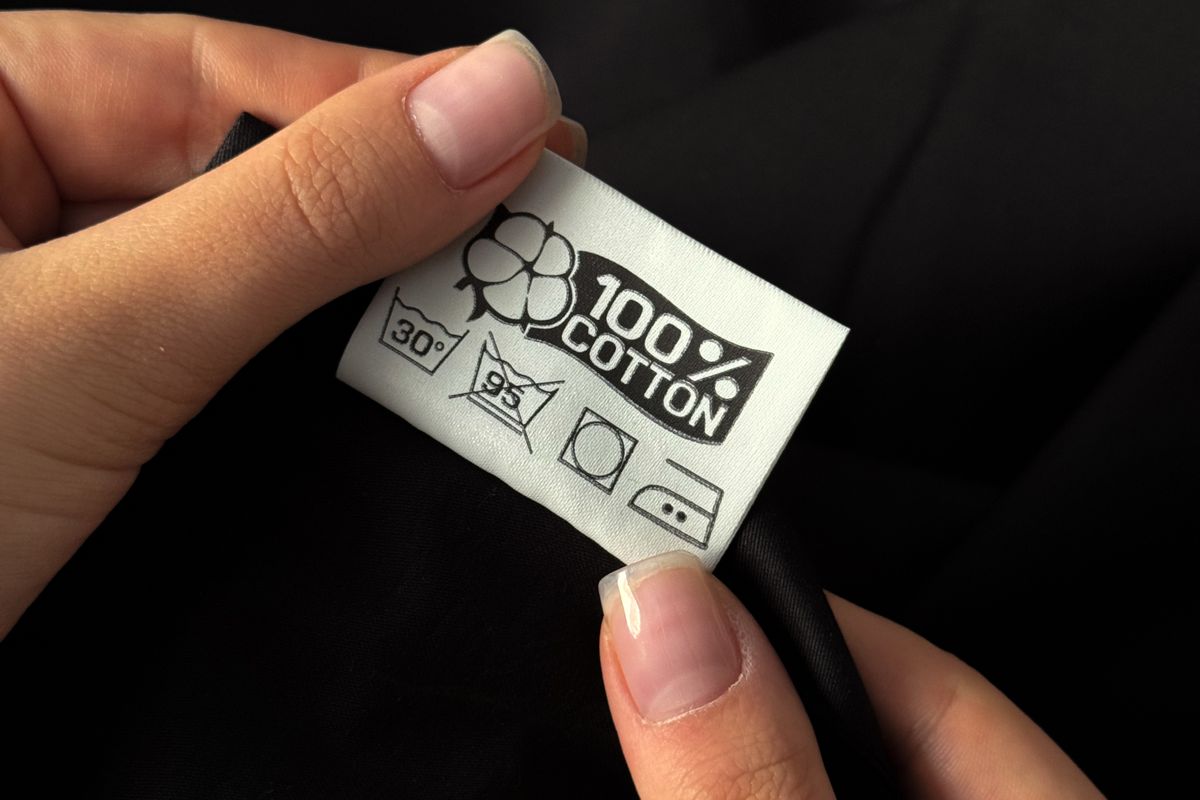
Symbols appear in a fixed order: washing, bleaching, drying, ironing, professional care. The washtub number is the maximum wash temperature in °C, and bars beneath mean reduced agitation — one bar gentle, two bars the wool cycle. A triangle is bleaching, and two diagonal lines inside it allow oxygen bleach only. A circle inside a square means tumble dry. Ironing is marked in dots: one caps at 110°C, two at 150°C, three at 200°C.
Three questions for brand support
- Is this chart body or finished-garment measurements, and if garment, has the flat width been doubled to a circumference?
- What tolerance applies to the one measurement I care about?
- What is the fibre composition, and was the measurement taken relaxed or stretched?
Ask before ordering; return clocks start regardless.
FAQ
- What is the difference between a spec sheet and a tech pack?
- The spec sheet is one page inside a tech pack. It holds the measurement points, graded size run and tolerances; the pack adds sketches, bill of materials and construction notes.
- Why does a garment arrive at a size the chart did not predict?
- The chart stated a target, not a fixed value. Every measurement point carries a tolerance, so a 60 cm chest specification can arrive at 58.7 cm or 61.3 cm and still be correct.
- Can I compare two brands using their size charts alone?
- Only if both use the same measurement points and both say whether the numbers are body or garment. If either is missing, the comparison is guesswork.
Maya Ellis
Writes about garment construction, leather goods and footwear specs. Started in retail floor management before moving to editorial research. How we research.