Silk Scarf Sizes: What 90, 70 and 50 cm Actually Do
A silk square's size decides which knots it can hold, and its weave decides whether they stay tied. Here is how 90, 70 and 50 cm squares differ.
Reviewed by Maya Ellis · Updated Aug 6, 2026
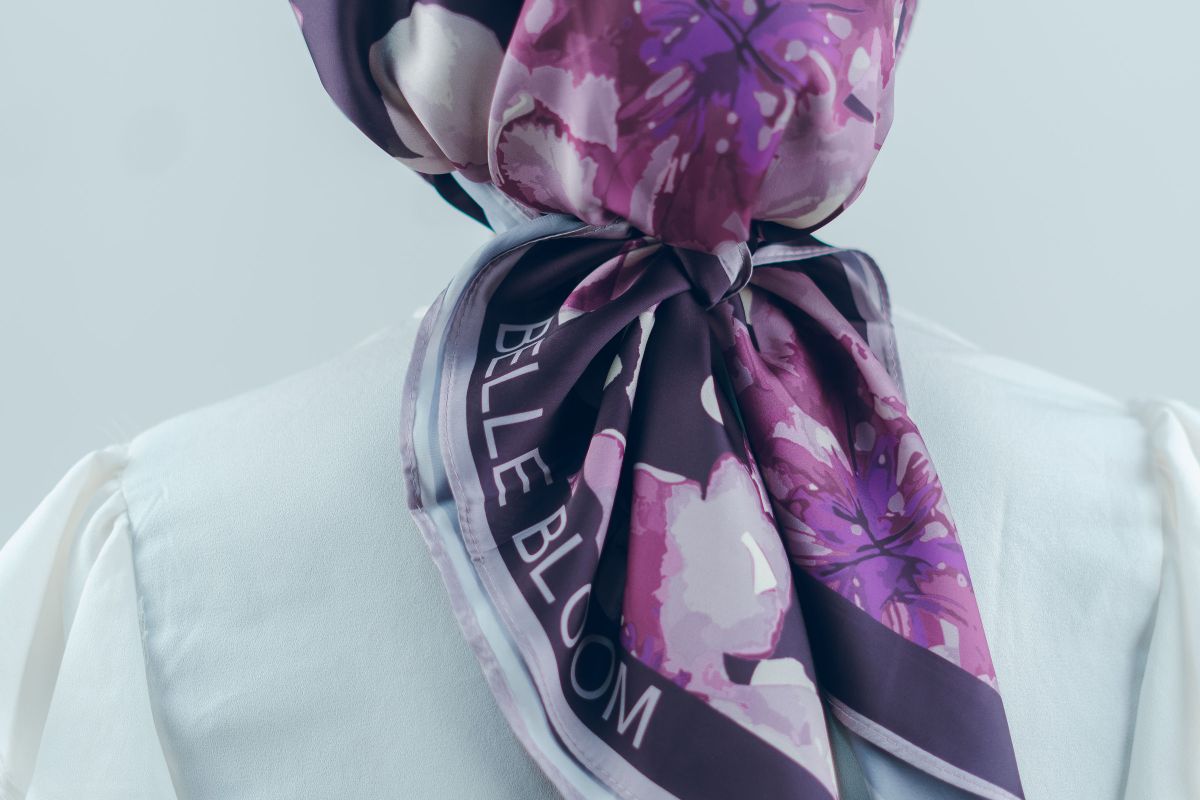
A silk square’s size decides which knots it can hold, long before the print does. A 50 cm scarf is a neckerchief and a bag handle. A 70 cm square takes a neck knot or a headband. A 90 cm square is the one that carries a Parisian knot, a shoulder wrap or a halter.
What each square actually folds into
| Square | Does well | Cannot do |
|---|---|---|
| 50 cm | Neckerchief, bag handle, ponytail tie | Parisian knot, shoulder wrap |
| 70 cm | Neck knot, ascot, headband | Parisian knot, worn as a top |
| 90 cm | Parisian knot, turban, belt, halter | Bulky drawn tight |
Most neck knots start with the bias fold — corner to corner, then rolled into a band. Rolling costs length, so a generous-looking square can come up short. Worn over the hair a scarf behaves like a hat, and hat sizing covers how much head volume a covering must clear.
Why a folded square is thicker in the middle
Folding on the bias doubles the scarf through the centre of the band and leaves the two corners as single-layer tails, which is why a square gives a knot a soft body and ends that taper. A long rectangular scarf keeps an even width from end to end, so it sits flatter under a lapel and gives a cleaner line down the chest.
Weave decides drape, and drape decides the knot
Twill is the traditional square-scarf weave: a diagonal structure, firmer and slightly matte, that holds a crease and keeps a rolled knot from collapsing. Charmeuse is a satin weave with long floats, glossy on the face and matte on the back — fluid for drape, slippery in a knot. Crepe de Chine uses twisted weft threads and wrinkles least of the three.
Weight is quoted in momme. Silk twill runs about 12 to 40 momme, crepe de Chine 12 to 16, charmeuse 16 to 30. Printed squares are usually built on 12 to 18 momme twill.
Telling silk from polyester without a label
Polyester satin throws a flat, uniform shine; silk has a softer lustre that shifts as the fabric moves.
The burn test settles it. Pull a thread from an inner seam, hold it with tweezers over a sink and light it. Silk burns slowly, curls away, smells like burnt hair and leaves a dark bead you can crush. Polyester melts, smells chemical and leaves a hard black bead. See how to read spec sheets for the rest of the label.
Washing, dry cleaning and the rolled edge
Hand washing in cool water with a pH-neutral detergent keeps silk soft. The risk is dye, so a saturated red or navy may bleed even cold. Dry cleaning avoids that, but repeated solvent cycles dull the lustre. Never wring wet silk; roll it in a towel and dry it flat, because hanging stretches the weave.
Both routes threaten the hand-rolled hem, which is stitched into a small tubular profile. A hot iron flattens it for good.
Size limits which knot you can tie. Weave decides whether it stays tied.
FAQ
- Is a 70 cm silk scarf too small for a neck knot?
- No. Bias-folded, a 70 cm square will wrap once and take a small knot. It will not carry a Parisian knot, which needs 90 cm.
- How can I tell if a silk scarf is real silk?
- Pull a thread from an inner seam and burn it. Real silk smells like burnt hair, burns slowly and leaves crushable ash; polyester melts into a hard bead.
- Should a silk scarf be hand washed or dry cleaned?
- Hand washing in cool water with a pH-neutral detergent suits most scarves. Dry cleaning is safer for saturated dyes but may dull the lustre.
Maya Ellis
Writes about garment construction, leather goods and footwear specs. Started in retail floor management before moving to editorial research. How we research.